
• Submissions
  • Support Us
  • nl Nederlands
  • en English
AVO Magazine - One click closer to Japan
  • AVO Magazine
    • AVO Magazine, who?
    • About us (日本語)
    • AVO Magazine presents
    • AVO Magazine Podcast
    • Join AVO Magazine’s Discord Server
    • Support AVO Magazine
  • Staff picks
  • Music
    • Japanese Music News
      • Concerts and festival news
      • Musical Snack
    • Curtain-raiser
    • Weekly MV Roundup
      • About: 7 New Music Videos You Need To Check Out
  • Japan-related Events
  • Interviews
  • Reviews
  • Reports
  • Colophon
  • Contact
    • Submissions
    • Join the AVO Magazine team
No Result
View All Result
AVO Magazine - One click closer to Japan
No Result
View All Result
Home Japan

The Japanese tattoo under pressure

sjooisu-san by sjooisu-san
8 April 2016
in Japan, News
Reading Time: 3 mins read
A A
0
De Japanse tatoeage onder druk

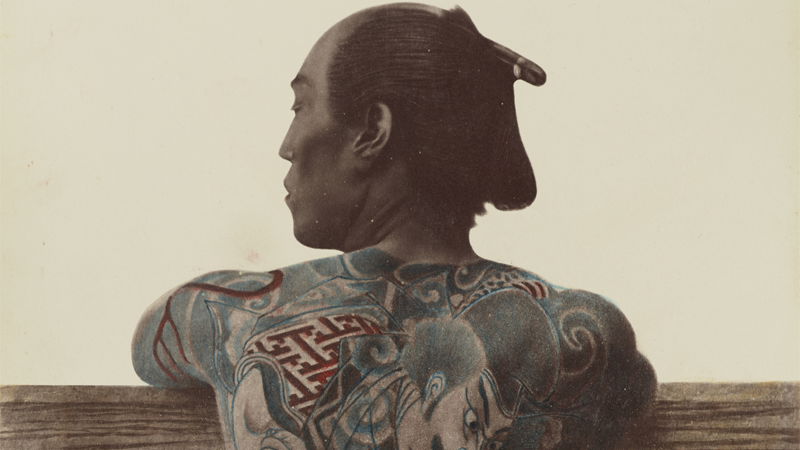
Japanese Tattoo; Kusakabe Kimbei (Japanese, 1841 - 1934, active 1880s - about 1912), or Baron Raimund von Stillfried (Austrian, 1839 - 1911); Japan; 1870s - 1890s; Hand-colored albumen silver print

For as long as I can remember, I have been a great fan of tattoo s. I really enjoy to read in on the different styles of the tattoo scene. For the last 9 years my focus has been mainly on the traditional Japanese tattoo the Horimono, beter known as the Irezumi.

I gather my information by ready books and following tattoo artists on the socialmedia, I love looking at all those beautiful pieces of art inked “into” bodies. I had a big shock when I heard that the Japanese government opened an “attack” on Japanese artists, in the beginning of this year. There was a tattoo convention shut down in Osaka and there where messages that tattoo artists had been arrested. I wanted to know more about what was going on and so I contacted the people behind the Facebook page, Save Tattooing in Japan. From this contact an interview was born that I would love to share with you.

Japanese Tattoo; Kusakabe Kimbei (Japanese, 1841 – 1934, active 1880s – about 1912), or Baron Raimund von Stillfried (Austrian, 1839 – 1911); Japan; 1870s – 1890s; Hand-colored albumen silver print

But before we go to the interview, first a little bit of history:

The Japanese tattoo has been around for centuries, but really gained popularity in the Edo period (1600-1868 AD). People asked artists for tattoo’s with scenes from the popular Chinese roman Suikoden. This roman is about rebellious courage and manly bravura, was very wanted among the people and was published and printed on wooden blocks. But next to the scenes from this roman, dragons, flowers, tigers and other mythical creatures where very popular too. For example, the firemen often had dragon tattoo’s to protect them selves against fire. Artists where populair and very wanted for their eye for detail and use of Nara ink. This type of ink changes color over time, when applied under the skin, from black to a green blue color and was mainly used to create waves.

Even though the Horimono was very wanted and popular in the Edo era, there was a dark side to tattoo s. In the Kofun era (300-600AD) there was a law in place to punish criminals with a crime tattoo, known as an Irezumi. Depending on the crime there would be a fitting tattoo placed, so the community could see what kind of criminal a person was. Because of this the Horimono got a bad name, while it also still meant art through ink. Even in the Edo era, punishment tattoo s where placed. And at one point, the government decided that tattooing would be made illegal.  This meant that tattoo artists and their clients needed to go underground. It was illegal and punishable to place a tattoo and also to receive a tattoo. If you got caught you would be convicted in an instant.
The government did this mainly to create a clean image for the West. Funny to know, actually, it was the ambassadors coming from the West to Japan, who where very interested in the Japanese Horimono. And they really wanted one inked “into” them selves. For these high and mighty man of the West the government made an exception. But the ban on tattooing was revoked in 1948.

Through out the years, the meaning of Horimono and Irezumi have been woven together. Now-a-days the word Irezumi does not have a negative meaning anymore. Also the way a tattoo is placed has changed. Originally everything was done by hand, but now most tattoos are placed with a tattoo gun. Still, there are a lot of Japanese tattoo artists who prefer to place a tattoo by hand. This is called Tebori.

It is time for the interview. Thanks to Manuel Chillagano and the team behind Save Tattooing in Japan, this interview was made possible. In my opinion it is of utmost importance that this form of art is protected. Especially in a country as Japan, where the way of making tattoo art is unique in its kind. People all over the world are fascinated by the Japanese tattoo and the disappearance of it would be a huge loss to the art community. You can read the interview with Save Tattooing in Japan here.

Sources: The Japanese Tattoo: door Sandi Fellman, Bushido, legacies of the Japanese tattoo: door Takahiro Kitamura en Katie M. Kitamura and Save Tattooing in Japan

Tags: 2016JapanJapan
ShareTweetShareShareShareShare
Previous Post

AVO Blog interview with Save Tattooing in Japan

Next Post

AVO interview with color-code

sjooisu-san

sjooisu-san

have fun ^^

Related Posts

Five close-up portraits of the members of alternative idol group Zenbu Kimi no Sei da. presented in a collage, showing the creative expression of all the members.
Japanese Events: Music

Zenbu Kimi no Sei da. celebrate tenth anniversary with first European tour

by Francisca Hagen
8 February 2026
0

The first European tour of the alternative idol group ぜんぶ君のせいだ (Zenbu Kimi no Sei da.) will commence shortly. Supported by...

Read moreDetails
A cropped version of a vertical photo of LiSA with pink hair in a bob-style and a black jacket with a leather corset. Photo by Hirohisa Nakano

LiSA will tour Europe for the first time

7 February 2026
Photo of Utaha from Wednesday Campanella on stage, dressed in a red and blue outfit with tartan print. It shows an energetic scene where she looks toward the audience and waves her arms. Additionally, Kenmochi Hidefumi is seen in the background behind the DJ equipment. The stage is illuminated by white and blue lighting, also contributed by the big screen behind the two members. Photo by JJ Grant (Wonderlens) on behalf of AVO Magazine

Live Report: Wednesday Campanella at London’s Heaven — Wednesday’s Child Is Full Of Grace

4 February 2026
The photo shows a darkly lit room with sound artist and composer FUJI||||||||||TA standing in front of his hand-built pipe organ. The sound artist is dressed in black clothing and stands with his body turned to the right while his face is facing upwards and he appears to be screaming. Photo by Tomohiko Tagawa

FUJI||||||||||TA tours Europe in April with ‘A School Of Sardines In The Pipe’

31 January 2026
The photo features the two HYPER GAL women sitting side by side on the roof of a building. Both are dressed in a black top and jeans, with their hair bleached or coloured, the two musicians look towards the camera lens. The photo was taken by Adam Armstrong (wespeakincolors on Instagram).

HYPER GAL to return to Europe for 2026 spring tour

30 January 2026
Next Post
AVO interview with color-code

AVO interview with color-code

Leave a Reply Cancel reply

Your email address will not be published. Required fields are marked *

AVO Magazine is more than just an online magazine about Japanese music and culture. In addition to covering Japan-related events in Europe, AVO Magazine also supports and organises them. Under the banner AVO Magazine presents, several concerts and festivals have been held, including AVO J-Rock Festival (2013) and AVO J-Music Festival (2018), featuring performances by Japanese (indie) musicians. More information about AVO Magazine can be found here.

Have news related to Japan or Japanese music you'd like to share? Feel free to send us an email.

Recent articles

Five close-up portraits of the members of alternative idol group Zenbu Kimi no Sei da. presented in a collage, showing the creative expression of all the members.

Zenbu Kimi no Sei da. celebrate tenth anniversary with first European tour

8 February 2026
A cropped version of a vertical photo of LiSA with pink hair in a bob-style and a black jacket with a leather corset. Photo by Hirohisa Nakano

LiSA will tour Europe for the first time

7 February 2026
Photo of Utaha from Wednesday Campanella on stage, dressed in a red and blue outfit with tartan print. It shows an energetic scene where she looks toward the audience and waves her arms. Additionally, Kenmochi Hidefumi is seen in the background behind the DJ equipment. The stage is illuminated by white and blue lighting, also contributed by the big screen behind the two members. Photo by JJ Grant (Wonderlens) on behalf of AVO Magazine

Live Report: Wednesday Campanella at London’s Heaven — Wednesday’s Child Is Full Of Grace

4 February 2026
The photo shows a darkly lit room with sound artist and composer FUJI||||||||||TA standing in front of his hand-built pipe organ. The sound artist is dressed in black clothing and stands with his body turned to the right while his face is facing upwards and he appears to be screaming. Photo by Tomohiko Tagawa

FUJI||||||||||TA tours Europe in April with ‘A School Of Sardines In The Pipe’

31 January 2026
The photo features the two HYPER GAL women sitting side by side on the roof of a building. Both are dressed in a black top and jeans, with their hair bleached or coloured, the two musicians look towards the camera lens. The photo was taken by Adam Armstrong (wespeakincolors on Instagram).

HYPER GAL to return to Europe for 2026 spring tour

30 January 2026
Facebook Twitter Instagram Youtube Soundcloud Discord
Online magazine since 2012 and based in the Netherlands. AVO Magazine is a Japan-related entertainment website with information about events in especially in Europe. There is a big focus on Japanese music. Other contents we publish are reports, reviews, informative articles, and interviews. AVO Forum, founded on May 16, 2003, served as the foundation for AVO Magazine.

Contact (Francisca Hagen): hello[@]avo-magazine.com

Please do not use text and photos made by AVO Magazine without permission. An email is easily created. Let's support each other!

Affiliates

JPU Records 1_General CDJapan

Featured on

  Lucydafirst - Crate Culture Podcast LOGO

AVO Magazine Approved

  • ANGURA
  • Arlequin Photography
  • Get Your Genki
  • Idol is SHiT
  • iPod of mine
  • J-POP streaming
  • Japan Jams
  • Japone Artists
  • The Sushi Times

Copyright © 2012-2026 AVO Magazine

Welcome Back!

Login to your account below

Forgotten Password?

Retrieve your password

Please enter your username or email address to reset your password.

Log In
No Result
View All Result
  • AVO Magazine
    • AVO Magazine, who?
    • About us (日本語)
    • AVO Magazine presents
    • AVO Magazine Podcast
    • Join AVO Magazine’s Discord Server
    • Support AVO Magazine
  • Staff picks
  • Music
    • Japanese Music News
      • Concerts and festival news
      • Musical Snack
    • Curtain-raiser
    • Weekly MV Roundup
      • About: 7 New Music Videos You Need To Check Out
  • Japan-related Events
  • Interviews
  • Reviews
  • Reports
  • Colophon
  • Contact
    • Submissions
    • Join the AVO Magazine team

Copyright © 2012-2026 AVO Magazine

This website uses cookies. By continuing to use this website you are giving consent to cookies being used. Visit our Privacy and Cookie Policy.