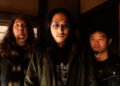


If you’re a little bit ‘into’ the visual kei genre, you’ve probably heard the name 摩天楼オペラ (Matenrou Opera) before. Existing out of 苑 (Sono) on vocals, 優介 (Yusuke) on guitar, 彩雨 (Ayame) as a keyboardist and programmer, 耀 (Yo) on bass and 響 (Hibiki) on drums, the band can be filed under the loud kei and tanbi kei subgenres of visual kei, but they also make use of a symphonic metal sound in their works.
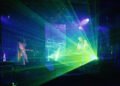
The band recently celebrated their 18th anniversary at Hibiya Open Air Concert Hall on August 10, unfortunately without guitarist Yusuke, who was undergoing treatment for a fractured arm sustained in late July. Luckily, the preparations for the band’s latest single AGONY were already completed, which means he does appear in full on the single and in the music video.
Ah, let’s continue to be covered in the world’s desires
When I see a music video, my main question is ‘how much do the visuals convey the story of the lyrics?’, and more often than not, this is a very difficult subject. Since a lot of lyrics are often describing an ‘emotional state’ rather than a ‘movement’ or an ‘action’. AGONY is no different in this scenario. As the name implies, the lyrics express a feeling of ‘agony’ and Sono has written them in a rather poetic style, as is more or less customary for him at this point. The lyrics hint at losing the will to move forward, covered in the world’s desires and the flood of voices echoing in the narrator’s head, sinking into the unwavering depths. So, ‘heavy stuff’ without being too detailed about it.
The style of the song is also more focused on the metal aspect, which is also more Sono’s style of composing. (The other song on the single, Another Christmas has a lot more keyboard in it, and has been composed by Ayame instead.) However, a new instrument is introduced in the introduction: a cello, played by 石井智大 (Tomohiro Ishii), adding an eerie vibe to the already more monotone vocals from Sono.
The music video itself opens with some drone like (although it’s more than likely done digitally, honestly) shots of some castle ruins, accompanied by the slow cello melody and more monotone vocals while Sono makes his way through a narrow hallway or corridor until the rest of the band joins in.
Since it’s quite hard to make a visual story with these lyrics, the music video mainly focuses on which member is taking centre stage with their instrument throughout, so during Ayame’s keyboard solo, Yusuke’s guitar solo the focus is mainly on them individually, followed by shots of Hibiki as his drums move towards the front. The same can be said for Yo when his sound is a little more prominent in the mix, since he doesn’t have a solo moment in this song. You’ll also see shots of the members in the same area as we saw Sono in the beginning, but their moments in front of the mirror are largely a ‘blink and you’ve missed it’-type of shot.
In conclusion, did Matenrou Opera completely miss the mark with their latest music video? No. Like mentioned earlier, it’s often extremely difficult to create a story-driven music video on lyrics that describe an emotional state, and AGONY is no different in that regard. What they did do is show us, the audience, what they’re good at. And that’s creating catchy rhythms combined with Sono’s high vocal style. Which means that if you’ve enjoyed their recent work, you’ll probably enjoy AGONY as well. It’s not completely new style wise, but it’s a slow evolution of the style that they’ve been slowly growing into. Similar to, but also evolving from, their latest full album 六花 (Mutsu no Hana).
For AVO Magazine we took a deeper dive into the music video for AGONY, but if you’d like to read more about the single as a whole, you can do so on my project, Arlequin Magazine. And before you ask: yes, I am that 雪 (Yuki), but due to a name conflict with Munch Munchies’ Yuki here at AVO Magazine, I’m using the name 夢 (Yume) instead.